

Peptide therapy has been getting more attention, and for good reason. Patients are looking for more thoughtful ways to support recovery, inflammation, metabolism, sleep, resilience, and whole-body wellness. But as interest grows, so does confusion.
Recently, the FDA’s Pharmacy Compounding Advisory Committee reviewed several peptide substances being considered for the 503A bulk substances list, including BPC-157, KPV, TB-500, MOTS-c, Semax, Epitalon, and Emideltide, also known as DSIP. The committee recommended six of those substances for inclusion on the 503A list, but did not recommend Emideltide. [1]
That sounds significant because it is. But it is also important to understand what it does and does not mean.
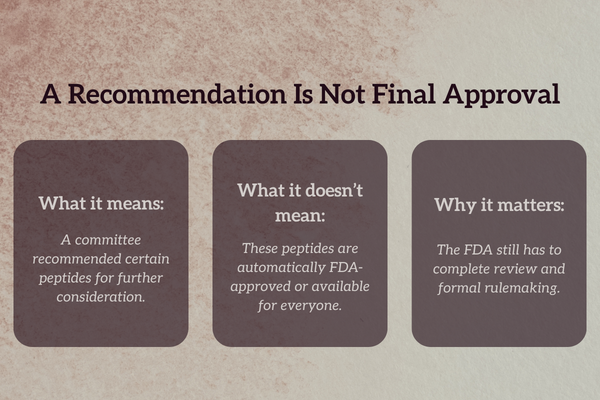
This vote was a recommendation. It was not final FDA approval. It does not mean these peptides are automatically available, broadly approved, or appropriate for everyone. Instead, it represents a potential step toward a more regulated, medically guided pathway for certain compounded peptide therapies.
And that distinction matters.
What Happened at the FDA Advisory Committee Meeting?
On July 23 and 24 of 2026, the FDA’s Pharmacy Compounding Advisory Committee reviewed several peptide substances that had been nominated for consideration under Section 503A of the Federal Food, Drug, and Cosmetic Act. These included BPC-157, KPV, TB-500, MOTS-c, Semax, Epitalon, and Emideltide. The FDA meeting materials listed the substances and the uses being evaluated, such as wound healing, inflammatory conditions, obesity, osteoporosis, insomnia, migraine, cerebral ischemia, and other conditions. [1]
The committee voted to recommend six peptides for inclusion on the 503A bulk substances list: BPC-157, KPV, TB-500, MOTS-c, Semax, and Epitalon. Emideltide, also known as DSIP, was the only substance not recommended.
This is meaningful because the 503A list relates to what traditional compounding pharmacies may be allowed to use when preparing medications for individual patients with a valid prescription. However, the FDA still has to complete its review and move through the formal rulemaking process before any final change is made.
In other words, this is a step forward, but it is not the finish line.
A Recommendation Is Not the Same as FDA Approval
This is the most important part to understand.
The committee’s vote does not mean these peptides are now FDA-approved drugs. It also does not mean pharmacies can immediately begin compounding anything they want, or that patients should view these therapies as risk-free.
The FDA’s own 503A guidance explains that state-licensed physicians and pharmacists compounding under Section 503A may use bulk drug substances only when certain criteria are met. These include substances that comply with an applicable USP or National Formulary monograph, substances that are components of FDA-approved drug products, or substances that appear on the 503A bulk substances list. Bulk substances must also have a valid certificate of analysis and come from an FDA-registered establishment. [2]
That is why this committee vote is important, but also why it should be interpreted carefully. A recommendation may help shape the path forward, but it does not replace final FDA action, pharmacy quality standards, provider judgment, or patient monitoring.
This is exactly where responsible education matters.
Why This Matters for Patients
For patients, the peptide conversation can feel confusing. One person may hear that a peptide is “banned.” Another may see it sold online “for research only.” Someone else may hear that a committee recommended it and assume that means it is fully approved. None of those interpretations give the full picture.
The real conversation is about access, safety, quality, and oversight.
At Revive, we do not view peptide therapy as a trend or a shortcut. Peptides are signaling tools, and they should be approached with respect for how the body works. That means context matters. The same peptide may not make sense for every person. The right plan depends on symptoms, goals, medical history, labs when appropriate, lifestyle, nervous system state, and how the body responds over time.
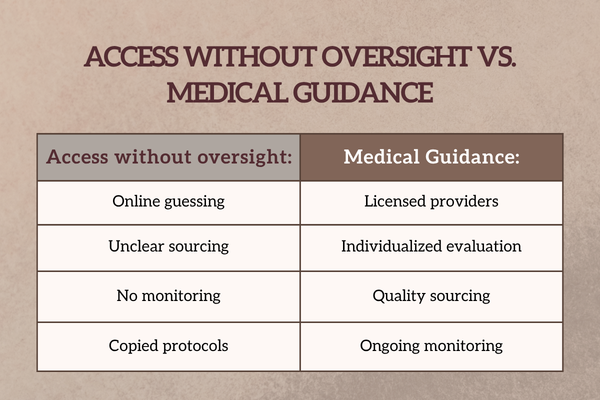
This is also why oversight matters. Peptide therapy should not be reduced to ordering something online, copying a protocol, or guessing based on what worked for someone else.
The Difference Between Access and Oversight
More access can be a good thing when it is paired with better safeguards. But access without oversight can create more confusion, not less.
There is a big difference between medically guided peptide therapy and unregulated products sold online. Medical peptide therapy should involve licensed providers, individualized evaluation, appropriate dosing, reputable pharmacy sourcing, and ongoing monitoring.
That does not mean the process has to feel intimidating. It simply means the body deserves more than guessing. This is especially important because many peptides are discussed online in oversimplified ways. They may be promoted for recovery, skin health, metabolism, sleep, inflammation, hormone support, or longevity without enough context around patient selection, quality, dosing, safety, or expectations.
That is where Revive’s approach is different. We believe education should come before treatment. Before starting, patients should understand what a peptide is being considered for, what it can realistically support, what it cannot replace, and what foundations may need to be addressed alongside it.
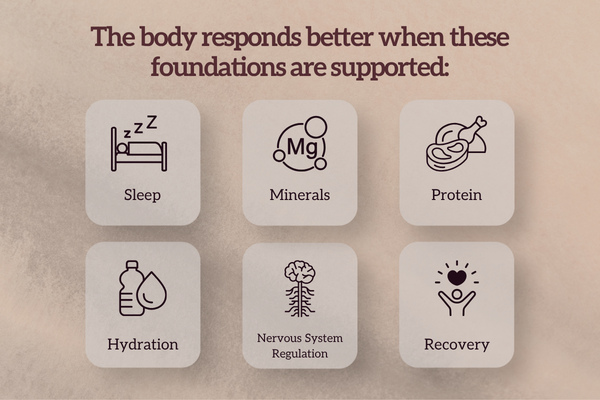
For example, peptides do not replace sleep, hydration, minerals, protein, or nervous system regulation. Our guide on peptides and supplements explains how peptides may send a signal, but the body still needs the raw materials to respond.
Why Quality Standards Matter
One of the biggest concerns in the peptide space is quality. When peptides are purchased from unregulated or unclear sources, there may be questions around purity, potency, sterility, storage, labeling, and consistency. This is not a small detail. It is central to patient safety.
The FDA’s 503A framework includes specific expectations around bulk substances, including certificates of analysis and manufacturing by registered establishments. [2] That type of quality conversation is very different from buying “research use only” products online and trying to self-direct a protocol.
A more legitimate pathway for compounded peptide therapy would not mean peptides should be used casually. It would mean there may be a clearer structure for appropriate use, when guided by trained clinicians and supported by responsible pharmacy standards.
That is the future of peptide therapy we believe in: thoughtful, medically guided, and patient-specific.
Peptides Still Require the Right Internal Environment
Even when a peptide is appropriate, the body still has to be ready to respond.
A peptide can send a signal, but it cannot override a body that is undernourished, under-rested, chronically stressed, inflamed, or missing key support. This is why two people can use similar protocols and have very different experiences.
The nervous system plays a major role here. When the body is stuck in survival mode, repair and regulation may not be the priority. This is also why Revive looks beyond the peptide itself. We consider the broader picture: sleep, stress, nourishment, hydration, hormone shifts, inflammation, recovery, and whether the body has enough support to carry out the signal.
Peptide therapy works best when it is part of a thoughtful plan, not when it is treated as a standalone fix.
What This Means for Recovery-Focused Peptides
Some of the peptides discussed in the advisory committee process, including BPC-157, KPV, and TB-500, are often talked about in the context of recovery, inflammation, wound healing, and tissue support. The FDA’s meeting page listed uses being evaluated for these substances, including ulcerative colitis for BPC-157-related substances, wound healing and inflammatory conditions for KPV-related substances, and wound healing for TB-500-related substances. [1]
This does not mean those peptides are FDA-approved for those uses. It means those were the uses evaluated during the advisory committee process.
That distinction is important for patients.
Recovery support should still be individualized. It should consider what is driving the need for recovery in the first place, whether the body has enough protein and nutrients to rebuild, whether inflammation is being addressed appropriately, and whether the patient is being monitored.
Why Education Matters More Than Ever
As peptide therapy continues to evolve, education becomes even more important. Patients need clear, honest information. Clinicians need strong training. Pharmacies need quality standards. Protocols need context.
That is deeply aligned with Revive’s philosophy. We do not believe patients should be overwhelmed by online peptide information, left to interpret research alone, or pushed into trendy protocols. We believe patients deserve a clear explanation of what is happening in the body, why a certain therapy may or may not make sense, and what kind of support should be in place before, during, and after treatment.
Education is not extra. It is part of safe, responsible care.
How Revive Approaches Peptide Therapy
At Revive, peptide therapy is never treated as one-size-fits-all. We look at the full picture before making recommendations. That may include symptoms, goals, health history, lifestyle, labs when appropriate, stress load, sleep, nourishment, current medications, and how the body is responding over time.
Our approach is built around:
- Medical oversight
Peptide therapy should be guided by licensed providers, not online guessing. - Personalized recommendations
The right peptide, dose, timing, and support plan depend on the person. - Quality sourcing
Where a peptide comes from matters. - Ongoing monitoring
The plan should be adjusted based on response, tolerance, and clinical guidance. - Foundational support
Peptides work best when the body has the support it needs to respond.
This is not about chasing the newest wellness trend. It is about using modern tools in a thoughtful, biologically supportive way.
A Reframe That Removes the Confusion
The recent advisory committee vote is encouraging, but it should not be misunderstood.
- It does not mean every peptide is approved.
- It does not mean every peptide is right for every person.
- It does not mean online sourcing is safe.
- It does not replace medical oversight.
What it may represent is a step toward a more legitimate and appropriately regulated future for certain compounded peptide therapies.
And that is the future patients deserve: not fear, not hype, not guessing, but thoughtful access paired with responsible guidance.
Peptides can be powerful tools. But they are still tools. The real value comes from knowing when to use them, how to use them, what to monitor, and how to support the body around them.

What This Means for You
If you have been curious about peptide therapy, this recent FDA advisory committee vote may feel exciting. It is a meaningful development in the peptide space, but it is not a reason to self-prescribe, buy unregulated products, or assume that more access automatically means better care.
The safest path forward is education, medical guidance, quality sourcing, and a plan that is built around your body.
At Revive, we help patients understand what peptide therapy can support, where it may fit, and what foundations need attention along the way.
If you are considering peptides or wondering whether your current protocol makes sense, the first step is not guessing.
Book a consultation to start the conversation.
Support starts with understanding.