

If you’re using peptide therapy or considering it, it’s natural to wonder what else should be part of the picture. Do you need electrolytes? More protein? Magnesium? A B vitamin? Does your nutrition need to change? It’s easy for those questions to turn into a long supplement list. At Revive, we think there’s a better place to start.
Peptide therapy is a broad category, and different therapies can have different mechanisms, evidence, risks, and considerations. There isn’t one supplement routine that makes sense for everyone. What does matter is making sure the everyday foundations of health aren’t being overlooked while you’re working with a medically guided plan.
That includes hydration, nutrition, protein, minerals, sleep, stress support, and thoughtful conversations about supplements when they’re appropriate.
Want the more detailed version? Keep reading, then unlock our free 25-slide Revive Guide to Foundational Support During Peptide Therapy. You can read the full guide online and download the PDF to keep for later.
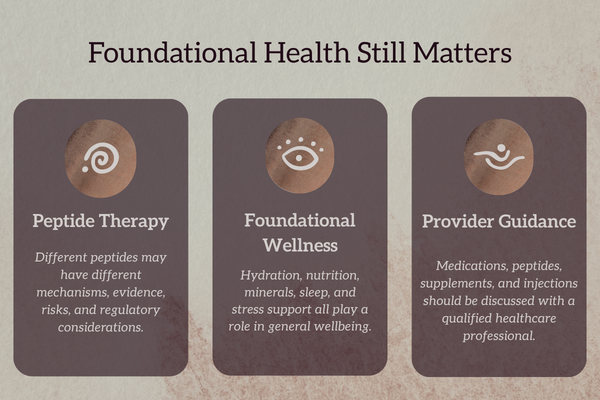
Foundational Health Still Matters
Peptide therapy doesn’t replace the basics, but the basics also shouldn’t be positioned as a way to make peptide therapy “work better.” They serve a different purpose.
Hydration supports normal circulation, digestion, temperature regulation, and fluid balance. Protein provides amino acids the body uses for normal maintenance and repair. Vitamins and minerals participate in processes throughout the body. Sleep and stress support remain important parts of overall well-being.
These habits don’t guarantee a particular treatment response. They aren’t a substitute for medical care, and someone shouldn’t feel as though a less-than-perfect diet or stressful week means they’ve somehow failed their protocol. They’re simply part of caring for the whole person.
That distinction is important because not every peptide is the same and not every person using peptide therapy needs the same kind of support. At Revive, the goal is to understand the person and the context around their care, not hand everyone the same checklist.
Before Adding More, Look at the Full Picture
When something feels off, it can be tempting to add another supplement. More magnesium. Another vitamin. Electrolytes. An injection. Something for energy. Something someone else said worked for them. But symptoms don’t always tell you exactly what’s missing.
Fatigue, dizziness, headaches, constipation, weakness, or feeling depleted can have many possible causes. They may relate to hydration or nutrition, but they can also be connected to medication side effects, changes in food intake, sleep, blood sugar, another health concern, or something else entirely.
That’s why we don’t recommend using symptoms alone to decide what supplement to add. Instead, it can be helpful to review nutrition, hydration, protein intake, sleep, stress, current medications, current supplements, any new symptoms, and labs when appropriate with your provider. The goal isn’t to guess your way into a bigger routine. It’s to understand what actually needs attention.
Hydration, Protein, and Nutrient Density
For some people, treatment can change appetite or how much food they’re eating. This is especially relevant for people using appetite-suppressing obesity medications such as GLP-1 receptor agonists.
Current clinical guidance emphasizes monitoring nutritional intake during treatment, with particular attention to adequate protein and micronutrient intake. The American Diabetes Association’s 2026 Standards of Care specifically recommend monitoring people using obesity medications for adequate nutrition and protein intake during active weight reduction. A 2026 joint advisory from major nutrition, lifestyle medicine, obesity medicine, and obesity organizations similarly emphasizes adequate nourishment, hydration, and preservation of lean mass during GLP-1 therapy.
That doesn’t mean everyone needs a protein shake, electrolyte packet, or vitamin regimen. It means that when overall food intake changes, food quality becomes worth paying attention to. Protein, fluids, fiber, vitamins, minerals, and enough overall nourishment still matter.
At Revive, we’d rather start by looking at the basics of what someone is actually eating and drinking than automatically build a large supplement stack around a treatment.
Supplements Still Need Context
Supplements can absolutely have a place in someone’s wellness plan, but “helpful” doesn’t mean “right for everyone.”
Take magnesium as an example. Magnesium is an essential mineral involved in normal muscle and nerve function, protein synthesis, blood glucose regulation, and energy production. That makes magnesium important physiologically, but it doesn’t mean everyone using peptide therapy needs to supplement it. Form, dose, medications, diet, health history, and individual needs all matter.
The same is true for B vitamins. Vitamin B12, for example, is required for normal nervous system function, red blood cell formation, and DNA synthesis. But fatigue doesn’t automatically mean someone needs B vitamins, and feeling stalled isn’t a reason on its own to begin injections. Diet, symptoms, medications, health history, and labs when clinically appropriate can help determine what deserves attention.
Zinc is another good example of why more isn’t always better. Zinc is an essential mineral involved in cellular metabolism, immune function, protein synthesis, DNA synthesis, and wound healing. However, prolonged high-dose zinc supplementation can interfere with copper absorption. Instead of routinely pairing zinc and copper or assuming zinc belongs in every protocol, the better approach is to review how much you’re taking and whether supplementation is appropriate for you.
NAD+ and omega-3s also come up often in wellness conversations. NAD+ plays fundamental roles in cellular metabolism, but researchers continue to note important unanswered questions around attempts to increase NAD+ levels therapeutically in humans. Omega-3 fatty acids are naturally found in foods such as fish and flaxseed and are also available as supplements, but dose, quality, diet, medications, and individual needs still matter.
The common thread is simple: supplements deserve context.
What to Be Careful With
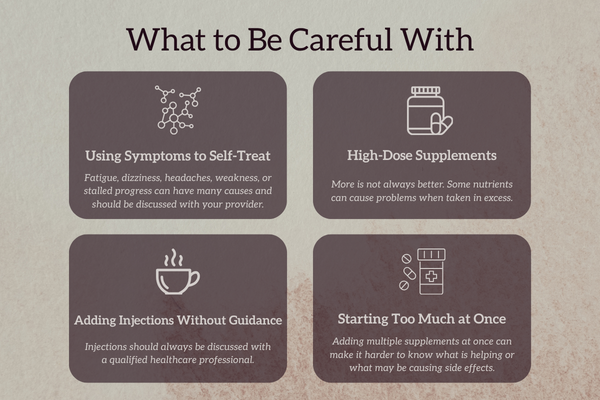
One of the easiest ways to make a wellness routine confusing is to start several new things at once. If you add three supplements, change your diet, begin injections, and adjust another part of your treatment at the same time, it becomes much harder to understand what’s helping, what isn’t, and what may be contributing to an unwanted effect.
It’s also important not to use symptoms as a reason to self-treat. Fatigue doesn’t automatically mean B vitamins. Dizziness doesn’t automatically mean electrolytes. Feeling stalled doesn’t automatically mean you need another peptide or supplement.
High-dose supplements deserve particular caution because nutrients can create problems when they’re taken in excess. Injections should also be discussed with a qualified healthcare professional rather than added because they’re trending or because someone online recommended them.
Thoughtful support doesn’t require the biggest stack. Sometimes it requires doing less and understanding more.
How Revive Approaches Foundational Support
At Revive, we don’t start by asking, “What else can we add?”
We start by looking at the full picture. That may include your goals, symptoms, current treatment plan, nutrition, hydration, sleep, stress load, medications, supplements, labs when appropriate, and how you’ve been feeling over time.
Two women may arrive with the same complaint and need completely different conversations. One may need to take a closer look at nourishment. Another may need a medication reviewed. Someone else may have a supplement routine that has become much more complicated than it needs to be. The right plan depends on the person, not the trend.
That’s also why foundational support and medical care aren’t competing ideas. Sleep, food, hydration, movement, and stress support can live alongside medically guided care without being presented as a replacement for it or a way to guarantee better results.
Want the Full Guide?
If you’d like a more detailed breakdown, we created the free Revive Guide to Foundational Support During Peptide Therapy.
The 25-slide guide walks through hydration, minerals, protein, magnesium, nutrient density, B vitamins, zinc, NAD+, omega-3s, nervous system support, what to be careful with, and what may be worth reviewing with your provider when something doesn’t feel right. You can unlock it directly on the Revive website, read it online, and keep the PDF for later.
And if you’re using peptide therapy, considering it, or wondering whether your current plan needs a closer look, you don’t have to piece everything together on your own.
Book a consultation to start the conversation.
Support starts with understanding.
This article provides general educational information and is not a substitute for individualized medical advice, diagnosis, or treatment. Do not begin, stop, or modify any medication, peptide, supplement, or injection without consulting a qualified healthcare professional. The appropriateness, risks, and potential benefits of any therapy vary by individual and by product.
Citations
- 2026 ADA Standards of Care for adequate nutrition, protein, and micronutrient monitoring with obesity medications. Diabetes Journals
- 2026 multi-organization GLP-1 nutrition advisory for nourishment, hydration, and lean-mass support. PubMed Central (PMC)
- NIH Magnesium Fact Sheet for magnesium’s established physiological functions. ODS
- NIH Vitamin B12 Fact Sheet for nervous system, red blood cell, and DNA functions. ODS
- NIH Zinc Fact Sheet for zinc functions and the high-dose zinc/copper interaction. ODS
- Nature Reviews NAD+ review because it explains both NAD+ biology and the remaining uncertainty around supplementation, which is exactly the tone we want. PubMed Central (PMC)
- NIH Omega-3 Fact Sheet for basic omega-3 biology and sources.