

Peptide therapy is often talked about like it’s one treatment. You’ll hear someone say they’re “on peptides,” see a stack shared online, or hear one person describe an experience and wonder if the same thing would make sense for you. But that language can make a very broad category of therapies sound much simpler than it actually is.
Peptides are short chains of amino acids, but that structural similarity doesn’t mean they all do the same thing inside the body. Therapeutic peptides have been developed for a wide range of medical uses, and different peptides can interact with different receptors, pathways, and biological systems. More than 80 peptide drugs had already reached the market across multiple therapeutic areas by 2021, which gives a sense of just how diverse this category has become.
At Revive, that distinction matters. We don’t think the most useful question is simply, “Which peptide should I take?” A better conversation starts with what a specific therapy is designed to do, what evidence exists behind it, whether it’s appropriate for the person considering it, and what kind of medical oversight belongs around it.
The Word “Peptide” Doesn’t Tell You What a Therapy Does
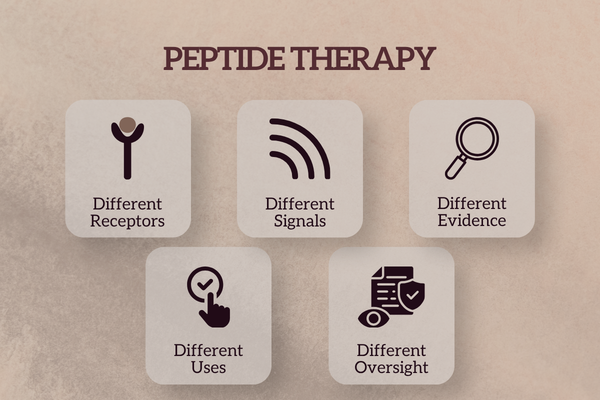
Peptides naturally play many different roles in human biology. Some act as hormones or signaling molecules, and many communicate by interacting with specific receptors on cells. Therapeutic peptides can be designed to activate a receptor, block it, or influence a signaling pathway in a particular way. Even peptides that interact with receptors from the same larger family can produce very different downstream effects. That’s why it isn’t especially useful to talk about what “peptides” do as though there’s one universal answer.
The same category includes peptide-based medicines used in very different areas of medicine. In 2026, for example, the FDA published revised product-specific guidance for 17 peptide drug products, including products containing semaglutide, liraglutide, glucagon, calcitonin, teriparatide, dasiglucagon, and pegcetacoplan. Those medicines don’t share one clinical purpose simply because they are peptide-based.
The mechanism matters. The individual product matters. The reason it’s being considered matters. That’s also why seeing someone else use a particular peptide doesn’t tell you whether that same therapy belongs in your plan.
Different Peptides Can Mean Different Evidence
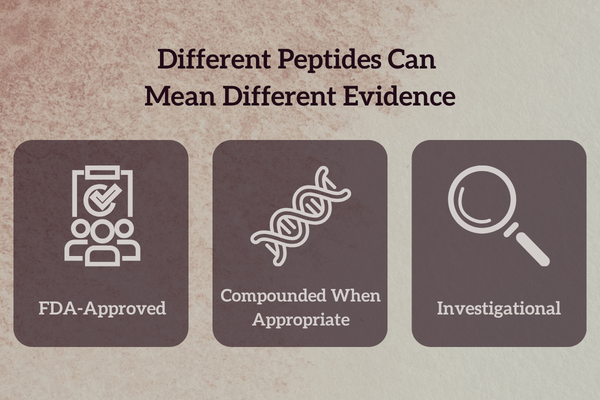
Another important difference is how much research exists behind a particular therapy. Some peptide-based medications have gone through extensive clinical development and FDA review for specific uses. Others may still be under investigation. Some substances may be discussed in the context of pharmacy compounding under specific federal requirements rather than as FDA-approved drug products.
Those categories shouldn’t be treated as interchangeable. FDA approval means the agency has reviewed a specific drug product for safety, effectiveness, quality, and labeling for its approved use. Compounded drugs are different. The FDA is clear that compounded medications are not FDA-approved, which means the agency does not review their safety, effectiveness, or quality before they are marketed. Compounded medications can still serve an important medical need in certain circumstances, but their regulatory pathway is not the same as an approved drug.
Even within compounding, there are specific rules around what bulk drug substances may be used. Under Section 503A, for example, a bulk substance generally must meet certain conditions involving an applicable USP or NF monograph, be a component of an FDA-approved drug product, or appear on the FDA’s 503A bulks list when the other conditions don’t apply.
For a patient, you don’t need to memorize all of those regulatory details. But you should know enough to understand that “peptide” does not automatically mean “FDA-approved,” “well studied,” “compounded,” or “appropriate for me.”
Those are separate questions.
Why Online Stacks Can Leave Out the Most Important Part
Social media makes wellness feel very shareable. Someone posts a routine, a supplement list, or a peptide stack, and naturally people want to know exactly what they’re doing. The problem isn’t that someone shared their experience. The problem is when their experience starts to look like a plan for everyone else.
A screenshot of someone’s stack doesn’t show you their health history. It doesn’t show their medications, symptoms, goals, labs, contraindications, provider conversations, or why a particular therapy was selected in the first place. It also doesn’t tell you what kind of evidence exists behind each component or how those therapies may interact with the rest of someone’s care. That context matters.
At Revive, we would rather help someone understand why something may or may not fit than hand them a list based on what’s currently popular online. Someone else’s experience can be interesting. It isn’t your medical plan.
More Isn’t Automatically More Advanced
There’s also a tendency in wellness to assume that a longer stack means a more sophisticated plan. It doesn’t.
Adding multiple therapies can create more variables to follow. If something changes, it may become harder to understand what contributed to the change, whether something is unnecessary, or whether one part of the plan needs to be reconsidered. A thoughtful plan isn’t measured by how many things are in it. Sometimes the more advanced decision is actually to keep the plan focused.
That’s why personalized care matters so much in peptide therapy. The goal isn’t to find the biggest combination of treatments. It’s to understand what the person is trying to address, which options have an appropriate evidence base, what risks need to be considered, and how the plan will be monitored over time.
That approach may be less exciting than a viral stack, but it’s a much better way to think about medical care.
Sourcing Is Part of the Conversation Too
Even if two products use the same peptide name, where the medication comes from still matters; there’s a meaningful difference between an FDA-approved medication, a medication prepared through an appropriate licensed compounding pathway, and a product marketed online for research use.
FDA guidance specifically warns that compounded drugs do not undergo the same premarket review as FDA-approved products and that poor compounding practices can lead to contamination, incorrect strength, or other serious quality problems. That’s why medication sourcing belongs in the conversation alongside mechanism and evidence.
At Revive, we believe patients should understand what they’re taking, why it’s being considered, where it’s coming from, and what kind of medical oversight is involved.
You shouldn’t have to become a peptide researcher yourself. But you should be able to ask clear questions and receive clear answers.
How Revive Thinks About Peptide Therapy
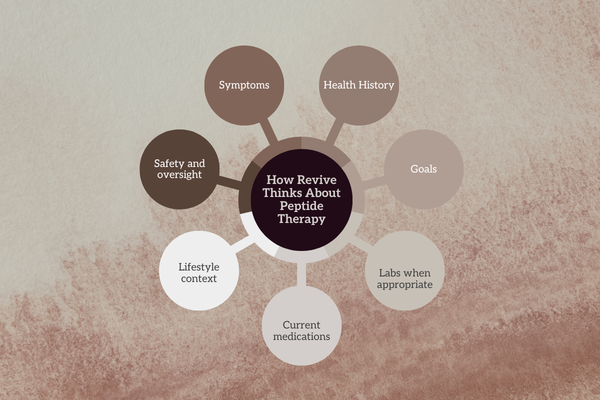
At Revive, we don’t approach peptide therapy as one universal treatment category. The conversation may include your goals, symptoms, health history, current medications, previous treatments, labs when appropriate, lifestyle factors, and whether a particular therapy actually makes sense for the person in front of us.
We also look at the bigger context around care. Our article Before Peptides: The Foundations Your Body Still Needs explains why hydration, nutrition, sleep, movement, stress support, and other foundations still matter when medically guided therapies are involved.
For readers who want to understand why sourcing matters, Why Medication Sourcing Matters: Not All Peptides Are Created Equal goes deeper into the difference between products intended for patient care and products marketed for research use.
And because the regulatory side of peptide therapy continues to evolve, our article Peptide Therapy Is Evolving: What the Recent FDA Committee Vote Really Means explains why an advisory committee recommendation is not the same thing as final FDA approval.
These are different pieces of the same larger conversation. The peptide matters. The evidence matters. The source matters. The person matters.
The Better Question to Ask
You don’t need to know every peptide name or understand every receptor before talking with a provider. You also don’t need to know what stack everyone else is using. A better starting point is asking, “What are we actually trying to support, and what kind of care makes sense for me?”
From there, a qualified provider can help determine whether peptide therapy belongs in the conversation at all and, if it does, which options deserve consideration based on the evidence, your health history, and the bigger picture of your care. Peptide therapy isn’t one thing. That’s exactly why personalized guidance matters.
If you’re curious about peptide therapy or wondering whether your current plan makes sense,
book a consultation to start the conversation.
Support starts with understanding.
**This article provides general educational information and is not a substitute for individualized medical advice, diagnosis, or treatment. Do not begin, stop, or modify any medication, peptide, supplement, or injection without consulting a qualified healthcare professional. The appropriateness, risks, and potential benefits of any therapy vary by individual and by product.
Research & References
And at the bottom of the blog, I’d now format it like this:
Research & References
Muttenthaler M, King GF, Adams DJ, Alewood PF. (2021). “Trends in peptide drug discovery.” Nature Reviews Drug Discovery. This review examines the growth of therapeutic peptide development across multiple areas of medicine and highlights the diversity of peptide-based drugs that have reached clinical use.
Davenport AP, Scully CCG, de Graaf C, Brown AJH, Maguire JJ, et al. (2020). “Advances in therapeutic peptides targeting G protein-coupled receptors.” Nature Reviews Drug Discovery. This review explains how therapeutic peptides can interact with different receptors and signaling pathways, helping illustrate why peptides within the same broad category can have very different biological effects.
U.S. Food and Drug Administration. (2026). “FDA Publishes Revised Draft Product-Specific Guidances for Certain Generic Peptide Products.” This FDA resource outlines updated product-specific guidance for multiple peptide drug products and demonstrates how regulatory and scientific considerations can differ from one peptide medicine to another.
U.S. Food and Drug Administration. “Understanding the Risks of Compounded Drugs.” The FDA explains that compounded medications are not FDA-approved and do not undergo the same premarket review for safety, effectiveness, and quality as FDA-approved drug products.
U.S. Food and Drug Administration. “Bulk Drug Substances Used in Compounding Under Section 503A of the FD&C Act.” This FDA resource explains the federal requirements that apply to bulk drug substances used in traditional pharmacy compounding under Section 503A.
U.S. Food and Drug Administration. “Compounding Oversight and Compliance Actions.” This FDA resource explains quality and safety concerns associated with inappropriate compounding practices, including risks related to contamination and incorrect drug strength.